Showing posts with label metalsmith. Show all posts

Sunday, November 9, 2014


“Good art is art that allows you to enter it from a
variety of angles and to emerge
with a variety of views.”
~Mary Schmich

Gayle Friedman

Before taking up jewelry, I danced a lot, mostly flamenco. I’m attracted to its joyful and intense emotions as well as the flamenco concept of duende: the notion of pushing oneself as close to the edge as possible, where one becomes uncertain of the outcome. This captures the way I like to make jewelry.

I’m interested in the stuff that flows in and out of our lives - a scrap of fur, a ceramic shard. These objects are often imbued with unexplored meaning and emotion. I’m drawn to relationships, and in making my jewelry, I get to explore the relationships that we have with these materials, where they come from and how they can be understood through the medium of jewelry.
Fragile Landscape

My work takes shape organically. I begin with a stone or some other found object and play with it until I am clear how to proceed. Sometimes this results in simple shapes and lines and other times pieces become more complex.

1. What led you to designing and creating jewelry?

Porcelain Pendant
​I was a ceramic sculptor for years before I even thought about jewelry. Over time, my sculptures grew smaller and smaller and were hung on the wall. Some of the pieces in my last show were only 3" tall. Then I stopped doing ceramics to help found an alternative school, where I spent 7 years. After I left the school I enrolled in a jewelry class and was immediately taken. It seemed so natural to make tiny things that hung vertically on the body.

2. Are you a full time artist and how did you make your way there?

Cocoa Pod Necklace
​Yes. I'm a full time artist, but I'm also the founder and director of Studio 4903, a working artist studio space that features jewelry. I'm fortunate to be able to sell out of the studio as well as around town and in some galleries throughout the country.​

3. Biggest challenge as an artist?

​​Marketing!

4. Describe your creative process?

​I'm very curious and drawn to many materials and processes. I find or buy or make things that interest and intrigue me. Then I sit with them, sketch a bit, sometimes working on pieces for months. I play with them, move them around, put them together and often take them apart and eventually I end up with a piece that feels right. ​

 5. What inspires you?

​Dirt/clay, negative spaces, hidden places, rocks that don't look precious, ​the stories behind things, "duende" or being on the edge and about to go over. Right now I'm really into a book I just got on wallpaper!

6. Tell me about the technical process you employ in your work.

​I mostly solder and pierce my work. Occasionally I'll cast pieces or carve in wax. I like using alternative materials, which constantly challenge me to come up with interesting and "right" ways of incorporating them. ​

7. How would you describe your artistic style and how has it changed over the years?

Clay Cup Earrings
​Eclectic. Somewhat funky. Far-flung. The bodies of work I've made have changed over the years, as I explore different themes and materials. I've been using some beads lately in my pieces, which I never would have thought I would have done when I first began making jewelry. ​

8. Any big plans for the future? Other shows, etc...

Fur Ring
​Studio 4903 will have its annual Holiday Show on December 14, from 1-5! Please come!
Oh, and a new website, which I'm working to develop! One where I can easily add new pieces I've made.​

9. If someone wants to purchase a piece from you (away from the show) what is the best way for them to contact you?

​or cell: 202.641.4248​


Courtney Gillen

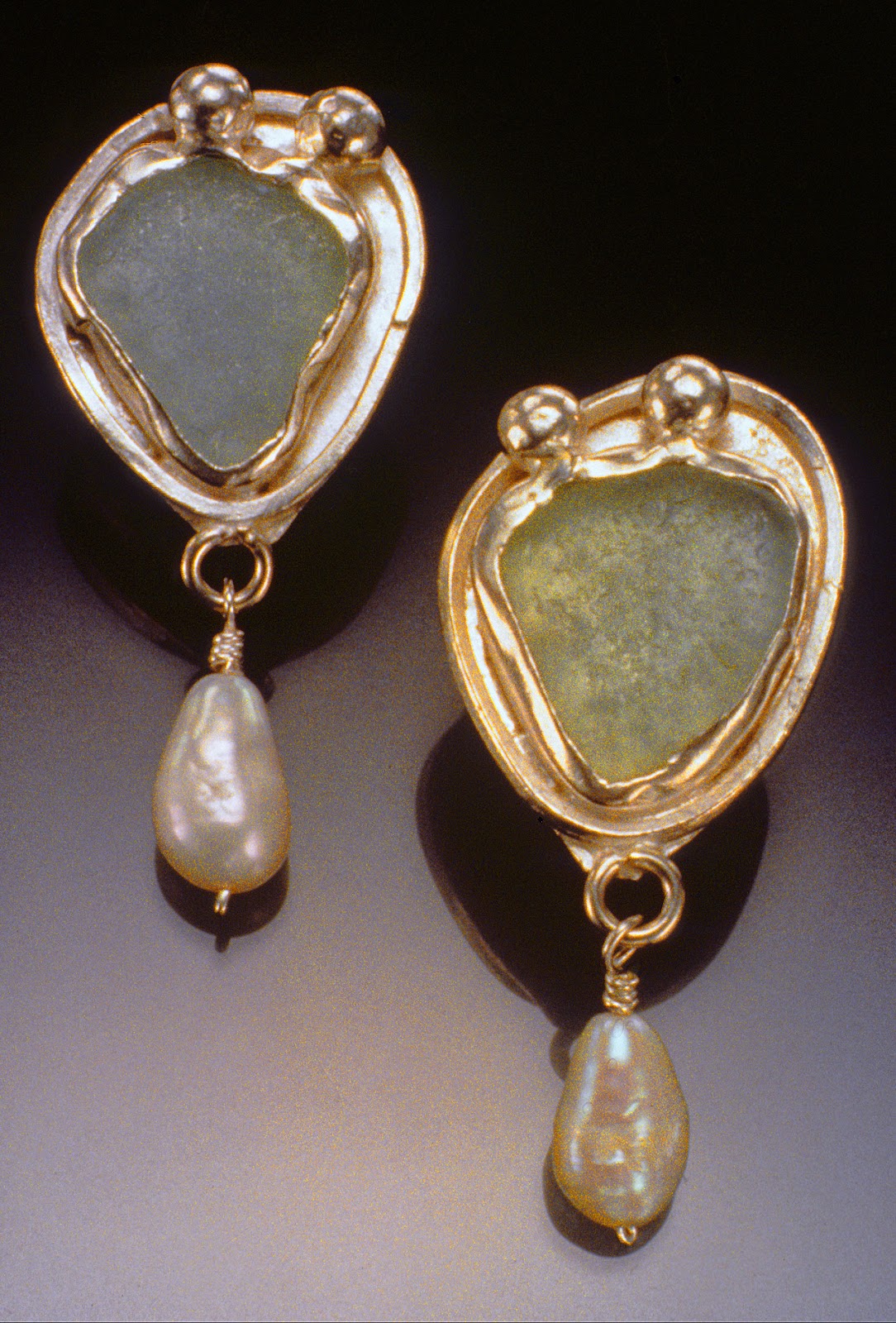
Sterling silver set with sea glass, recycled glass and pearls. Designs are clean and simple, often taking inspiration from the glass itself. All work is done using traditional metalsmiting techniques.

I have been a full time jewelry maker for over 18 years, doing about 17 - 20 shows per year and selling to stores and galleries around the country. My specialty is sea glass.
I first discovered sea glass about twenty years ago when a family member moved to Hawaii and out of the blue sent me a box of sea glass with a note "this might make nice jewelry". At the time I was starting out and my work resembled an amalgamation of many different techniques. There was no cohesion. The sea glass brought it all together. I fell in love with it, its gorgeous subtle look, and the unique shapes and colors.

This material matched my metalsmithing style, which is organic in nature. I like to just jump in with my silver at my work bench. There are often no plans for the work day other than it’s an earring day. My sketch books are full of loosely drawn ideas, but often the designs are created in the moment at the bench. I have still not tired of this material even after all this time. It’s still a thrill to go though my vast collection of sea glass and wonder what its previous life was and how old it is.

The majority of my collection I have personally gathered, mostly from old dump sites on the western shores of Kauai, Hawaii. I also incorporate fresh water pearls and recycled glass in the work. All the work is a one of a kind due to the nature of the sea glass. That is what is so fun about this material; unlike calibrated stones each has a different shape. This also means this work cannot be mass produced. Much of the sea glass jewelry on the market today is wire wrapped or drilled, not my jewelry, my glass is bezel set in hand fabricated settings which are often inspired by the glass itself.

This material has become more scarce in recent years due to the use of plastic bottles and recycling. It is rapidly disappearing off North American beaches as people collect it. We no longer dump refuse into the ocean and we recycle glass. Now there are sea glass festivals, books, lectures, and even sea glass associations. Back twenty years ago when I started working with it many people thought I was crazy thinking anyone would buy it. At the time there were only a handful of jewelry artists using this material. There are many more now, my work stands out because of my many years of experience with it, and my love of metal working.


Sandra Zacharia

I use shell forming, fold forming and raising techniques to create graceful forms that follow the patterns of nature. Using silver, gold, copper and bronze, each piece is handcrafted in silver, gold or bronze with added textures and patina.


The clean lines in my jewelry reflect an endurance within nature, ...the beauty of seashells washed ashore a thousand times, ...the delicacy of veins outlining the leaf that has long since crumbled and blown away. It is this tension between the stamina and fragility in nature that infuses my work with a life of its own.

1. What led you to designing and creating jewelry? 
     
I like to see things in terms of the patterns they create. The ones presented to us in nature are fascinating because they are just there, and they’re always perfect. The ones that we create ourselves just by manipulating things are exciting. If you let yourself go, you never know where you’ll end up. Often, without planning to, I’ll find myself right back at nature. 
I love to work with metal. Before I made jewelry, I was a textile designer. For me it was essentially the same thing, only then, the patterns were two dimensional.

2. Are you a full time artist and how did you make your way there?

Jerusalem Studio
At this point, I make jewelry full time, but I didn’t always. I went to F.I.T. and started out as a textile designer. For years, while I was living in New York, I designed fabrics for the fashion industry. Later, I moved to Israel where I raised my two oldest children and studied jewelry design at the Bezalel Academy in Jerusalem.We left Israel and came to live in the DC area nine years ago. Soon after, I was able to begin making jewelry full time. I work in my home studio. I participate in several shows throughout the year, and I'm a member of 2 galleries, the Waverly Street Gallery in Bethesda and The Jerusalem House of Quality in Israel. All this keeps me pretty busy in my studio.

3. Biggest challenge as an artist?

Silver  Knot
I’ve worked hard to refine my work. Getting to the core, finding what really moves me in a piece, clearing distractions…
Knowing what I need to do and finding the discipline to do it, is a great challenge for me.

4. Describe your creative process? 

Work In Progress
I like to doodle through the creative process. I usually begin with copper or brass. I'll cut a piece in a shape that pleases me and then just start playing with it. I don't plan in the beginning. It's more a stream of consciousness type of thing. As I hammer and manipulate the metal I get inspired by what it's becoming.Most of my inspiration comes from the process of doing. Only then do I decide want it is. At that point I'll begin to adjust my work to make the pattern. I cut it from heavy card stock and then from metal. Once I have something that I like I play with different variations of it until the idea eventually morphs into something new.

6. Tell me about the technical process you employ in your work.

Sky Blue
I combine different forming techniques. Whatever I need to do to get the metal to flow. I primarily use fold forming, anticlastic raising and synclastic forming. 

7. How would you describe your artistic style and how has it changed over the years?

Metamorphosis Cuff
I like to think of my style as earthy yet clean. When I started out I didn’t use any forming techniques. Everything was fabricated, meaning I would cut and solder to create my pieces. Now my work flows. I hammer and form. Its very liberating.

9. If someone wants to purchase a piece from you (away from the show) what is the best way for them to contact you?

Ocean Blue
The best way to reach me is by email artjewelsz@gmail.com), throughout Facebook (www.facebook.com/artjewelsz) or my website (www.artjewelsz.com). My work can also be seen at the Waverly Street Gallery in Bethesda, MD.

Slider

Tuesday, October 28, 2014


"Art completes what nature cannot bring to a finish." ~Aristotle

Carol Oshinsky spends much of the year in Massachusetts, providing her with the inspiration that drives the work she creates in her basement studio upon her return.

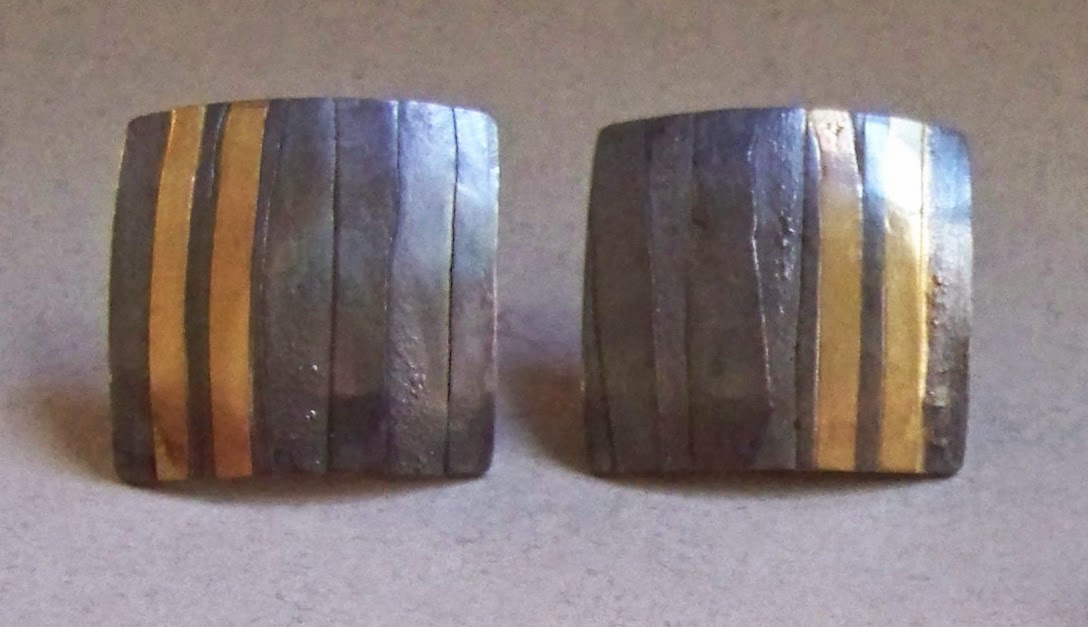
“Texture and the shapes created by edges that don’t quite meet fascinate me.  Most of my work reflects this interest. My textures are created by hammering metal into rocks or pitted chunks of iron, through fusion of bits and pieces of silver and gold, by surface embellishment using hammers, gravers and burs.

Berkshires in the Fall
The landscape of the Northern Berkshires is the inspiration for most of my pieces.  Although I do not translate literally what I see in the mountains and fields, with a little imagination my brooches become framed paintings in metal and gems that speak of the ever-changing hills of a most beautiful part of New England.”

1.  When did you join Pleiades?

Can't remember how long I've been with Pleiades.  I met the members through Washington Guild of Goldsmiths.  I was asked a number of times to be a guest artist - had lots of fun and sold some things.  Sometime after 2000 I was asked to become a permanent member, and I accepted.

2. What led you to designing and creating jewelry?

How did I get started making jewelry?  In the 70's Treasure of the Pirates (long gone) offered silversmithing classes.  I wanted to learn how to repair some of the broken silver pieces I had.  Once I learned to solder, I was hooked.  The variety of techniques to learn and things to make were endless.  WGG offered workshops with wonderful teachers and I took as many as I could.

3.  Describe your creative process.

Landscape 1
I play with the metal and see where it leads me.  I love textures and patinas.  I get my inspiration from things around me, mostly when I'm in New England.


4.  Where do you get your inspiration?

My inspiration comes from rural New England, nature, fine art - I make pins of abstract landscapes, insect pins, and I have made earrings that were inspired by Rothko paintings.

5. Tell me about the technical process you employ in your work.

I hammer into rusty steel to create textures and I fuse copper, steel, and gold  - fuse bits and pieces, roll out, fuse more, roll out, fuse more until I like the texture I have.  Patinas & polished high points accentuate the textures.

6. How would you describe your artistic style and how has it changed over the years?

My artistic style? - I don't have a name for it.  I play and lose myself in the process.  Sometimes I make a piece that is worth saving, sometimes it is a failure and ends up fused in pieces into something else.  Fortunately my livelihood does not depend on what I create.  I don't have to think about the saleability, marketability, or profit margin of what I make.  That's a huge plus.  I am lucky to have Pleiades because the sales I make allow me to thin my inventory and give me the push to make more.

7.  Any big plans?

Urban Renewal
No.  I have raised my family, retired from the money making job, and now I want to do just what moves me.  In the warm months I spend much of my time gardening.  I get a charge out of going into the garden to decide what's for supper.  Back in Maryland in the winter I do spend time at the bench unless the basement is too cold (last winter). 

8.  If someone wants to purchase a piece from you (away from the show) what is the best way for them to contact you?

The best way to buy a piece of mine is to come to the Pleiades show.  Goldsborough Glynn Antiques on Howard Ave. in Kensington sells some of my pieces, too. 

Tuesday, September 2, 2014

"Email" means more than you think!

"The word enamel comes [from] the High German word 'smelzan' later becoming 'esmail' in Old French. Hence the current usage of 'smalto' in Italian, 'email' in French and German and 'enamel' in English.

It is thus defined as a vitreous, glass like coating fused on to a metallic base. In history, enamels were initially applied on firstly gold, then silver, copper, bronze and more latterly on iron and steel. The term is also used for the application of decorative fusible glass applied to glass objects."
[i]

"Enameling is a good fit for me because I am strongly influenced by accidental occurrences and I like to experiment. The kiln offers many accidental occurrences, but I have learned in art as in life you have to accept risk and failure in order to move ahead. Sometimes we have to play the game of life with sweaty palms!" Pat Perito

While working as an R.N. Pat became interested in metalsmithing after collecting several strands of African trading beads and other beads from all over the world.
Chihuly inspired brooch
Two hundred necklaces and three years of metal classes at Montgomery College, she began working with enamels in 1980.


Ten years later she set up a studio in her home and continues to take enamel workshops all over the U.S. Pat regularly exhibits with the Washington Guild of Goldsmiths.

Pat’s love of color initially attracted her to enameling. She is  fascinated by the results of accidents that can happen as part of the process. “Hopefully you remember what you did and kept notes. Stretch yourself, you’ll learn something each time.”

Tabletop Art
One year Pat dropped her annual tabletop piece when taking it out of the kiln, she popped it back in and it is now one of her favorite pieces. However that has not become a mainstay technique to try to recreate the result! “It’s the mistakes that give you a whole new road to travel.”

Inspiration is found in parts of things -- a corner of a Monet garden, nachos, butterfly wings, the view from
Nachos inspired necklace
(her son ate one model)

her studio into the yard, just a small piece not the whole thing -- that lend themselves to a series of pieces. “I’m always looking. Something that’s fascinated me for years, after a storm, someone pulls out of the driveway leaving a puddle of water with a bit of oil floating on it, a flat rainbow.” Pat is about to start sketches for a series of pieces inspired by Hubble Telescope images a friend sent to her.

Wall Art
Although she takes inspiration from abstract and impressionist artists Pat describes her work as contemporary not traditional. She likes “to take cloisonné and make it more current, see where I can push it.”

One of the original seven “sisters” of Pleiades, Pat will be on sabbatical in 2014. Is she sad to miss this year’s 29th Anniversary? “Yes, but I need to have knee surgery!” However, she fully expects to return for the 30th!