Monday, October 6, 2014


Flow with whatever may happen and let your mind be free. Stay centered by whatever you are doing.
This is the ultimate. ~ Zhuangzi

Jan Mandel drapes jewelry like she used to drape clothing. “I build it around the body form in 360 degree format.  I do not cast, or work flat. I build/drape my materials on mannequin forms that I have collected over time in order to visualize the flow and movement of the material.  This flow of metal as it surrounds the body is key to my process, with the negative space that results equally as important!   It is the negative voids that are created in the structures that allow my work to breathe and flow.

With a degree in Clothing Design from Moore College of Art and Design in Philadelphia, Jan started as draper/pattern maker working in NYC/Philadelphia and the West Coast. This parlayed into a career in Interior Design, starting in restoration and conversion of historic spaces. Her draping skills served well in one-of-a-kind hand-draped window treatments. The opportunity to do a couple of Symphony Design Houses in both Baltimore and Washington DC altered her world. If that wasn’t enough, she began taking classes at Montgomery College in Metals.

Classes with Komelia Okim, Jan Maddox and Dorothea Stover honed her metals techniques and she was hooked. Another life altering experience! “The manipulation of metals became a passion.” Wanting even more exposure, Jan entered the University of Washington, Seattle to get a Masters in Metals, studying with Mary Lee Hu and John Marshall. Upon completion of her degree in 1999 her career took off. International and national exhibitions followed; the chance to document and research the Boucheron Jewelry archive in Paris led to an invitation to exhibit tiaras at the Victoria and Albert Museum, London. Thus was born her Transformational Jewelry line.

Most of the jewelry that I create can function, as both sculptural and wearable objects. These pieces derive their identity from process, rather than narrative.  Asymmetric, gold wire structures that defy their fragile appearance, evoke mass where there is none, relying on the viewers eye to visualize the unseen.  I work with 18K golds of varying colors, large freshwater pearls and unusual, irregular shaped stones. The work can be
intensely tight (fretworks)...or extremely minimalistic. It is the play of light and the premeditated negative space within these fretworks that engage the wearer and allow the stones to float on the body. Due to their sculptural aesthetic when not worn, these jewels can be displayed on a wall or pedestal.” Every piece is one-of-a-kind.


Jan’s work is included in The Renwick Gallery of the Smithsonian American Art Museum. She first exhibited with Pleiades as a guest in 2001 and 2003, becoming a member in 2004. If you would like to see more or to contact Jan to purchase a piece please check her website.

Thursday, October 2, 2014

It's easy to be enamored of the color but there is more to it than that!


I found I could say things with color and shapes that
I couldn't say any other way - things I had no words for.
 ~ Georgia O'Keeffe

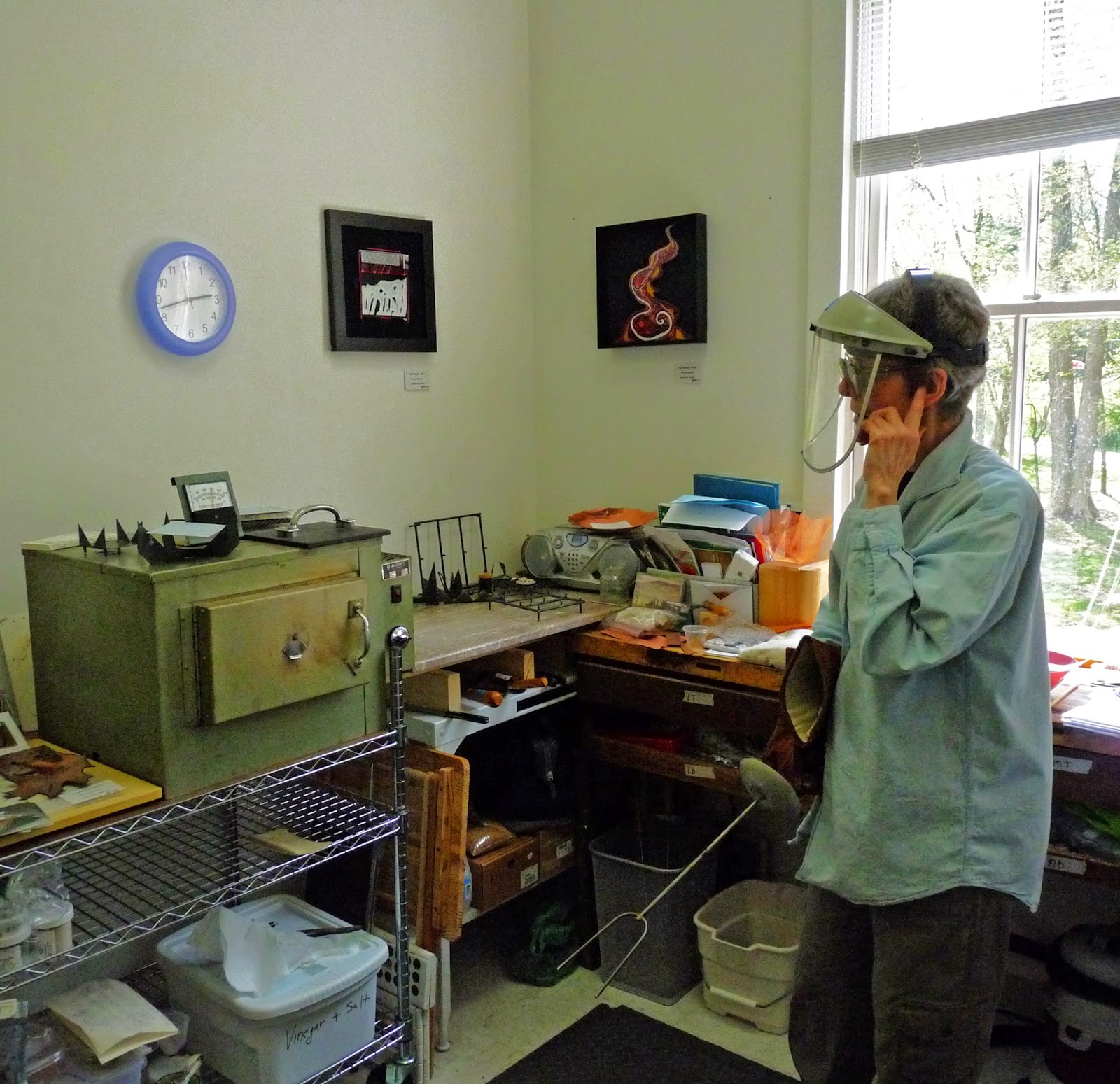
Susana Garten sometimes can’t get her pieces to do what she wants. She was working on a wall piece with 2” squares of 22/24 gauge copper, she was hammering away, but it just wouldn’t cooperate, so she took it out to her driveway and ran over it a few times. Perfect!

While Sue was at MC working on her degree in Art, she took Jan Maddox’s 2-D/3-D Survey of Crafts class. At first she couldn’t decide between weaving and enamel, but the way color and texture could be worked in the enamel “sealed the deal” and “so much for the degree!” In 1997 Sue was invited to be a guest artist in the Pleiades Art Jewelry show, shortly thereafter she joined as a member.

Initially she created cloisonné jewelry, but soon moved onto smaller vessels, hammering out bowl forms (now she uses spun forms and shaping) in copper and switched to “basse-taille[1], firescale[2]  and precious foil enamel techniques as a means of expression.”[3] Sue also does a fair amount of etching (resist, asphalt, contact paper – ferric acid – sometimes adding cloisonné wire – sometimes stencils – cleaning, washing – lay on enamel – fire over and over again). Still you never really know exactly what the end result will be or even exactly when the end will be. Occasionally a piece she thinks will be marvelous turns out horrible, so she puts it away and returns to it later. One piece she came back to, she stepped on a bit and it turned out to be terrific.

Sue used to sketch out ideas, but now finds she only does that when an idea gets stuck in her head and needs a push to realize. Typically, she prefers to play with the materials or works with 3D models to see what will spark. With her studio housed in the Sandy Spring Museum she finds herself taking inspiration from the pieces surrounding her. A 19th Century scissors case or lace collar present a host of possibilities in color, texture or flow. Then the experimentation begins. It’s not so simple that you just apply the enamel to the surface, fire and you’re done, but takes sample after sample, firing after firing to get the effect that is the vision in Sue’s head.

Sue finds that she constantly learns something from teaching enamel workshops and classes. "Someone always asks a question I had never thought of!" Since she doesn't like making frames, her wall pieces tend to be more abstract. "Some idea, some inspiration that leads to the design. My style is all over the place. I like to experiment. Having started doing cloisonne my work has gotten freer, more playing around and the more playing around the more I want to do." Sue takes her inspiration from nature, fiber, everyday occurrences, random internal thoughts and texture, color and pattern play important roles in every piece.

While she loves making the larger vessels and wall pieces, reality may cause a return to jewelry, holding the weight of an 18 gauge bowl while putting the enamel on is taking its toll. For now, however, she’s busy creating a collection of new work to present both at the Pleiades Show, but also for an exhibit of her work at Glenview Mansion opening October 5 of 16-24 pieces, a "Teacher's Pet" show with former students at the Pearson Legacy Gallery in Deer Isle Maine October 8-26 and for the Washington Guild of Goldsmiths show in November.

If you would like to see more or to contact Sue to purchase a piece please check her website.


[1]A low-relief pattern in metal, usually silver or gold, by engraving or chasing. The entire pattern is created in such a way that its highest point is lower than the surrounding metal. A translucent enamel is then applied to the metal, allowing light to reflect from the relief and creating an artistic effect. It was used in the late Middle Ages, and then again in the 17th century. The Art of Fine Enameling
[2] The use of the oxide buildup on a metal. Some pieces are completely done through firescale manipulation (by painting with a holding agent, sifting transparent enamels, and building up the resulting firescale lines), and some pieces are enhanced by the additive use of firescale (could be from a flaked-off piece that is reattached). The Art of Fine Enameling
[3] http://susanagarten.com/home.html

Friday, September 26, 2014

Not just a doodle...


Jan Maddox always intended to teach art, but while an arts major at University of Nebraska she needed an extra class and there was this credit jewelry class offered at night. Although a very primitive class, they enameled over a Bunsen burner, here was a whole new world of tools, vocabulary and materials. Her first piece was a cabochon setting in a ring. The instructor was a talented watchmaker trained at Elgin National Watch Company. Years later Jan taught the course.

Quarter Circle Pin with Damascene Inlay from The Art of Jewelry Making by Alan Revere

Graduate school took her to Indiana University where she had the opportunity to study under Alma Eikerman who had established an exceptional metals program which trained many of the country’s top jewelry teachers and jewelers.  On her own, Jan found that ceramics was too demanding in space and equipment and painting wasn’t quite doing it for her, but jewelry she could do in her kitchen (she used to make copper ashtrays on her stove). With a primitive set of tools she created a line of jewelry that “didn’t look like it came out of a jewelry store”. 

1967 found Jan teaching part time at Montgomery College where she set up the Art Appreciation courses and in 1971 upon completion of the Arts building in Rockville she went full time, teaching art appreciation, two and three-dimensional design, jewelry and general crafts over the next 25 years. All the time creating her own well received body of work.

In 1984 she joined Joke Van Ommen in opening Vo Galerie in DC, now Jewelers' Werk Galerie. This small space focused on contemporary jewelry, primarily from Europe, but also featured many American jewelers. Although only there for a short time, Jan learned about retail, what suits different people and as a result feels her pieces are only complete when she sells them and they become “someone else’s treasures.”

The challenge of the design enthralls her. “I like to start with something in hand, 2 squares and a bunch of circles of different sizes lead to sketches of different ways to arrange them.How big are the elements, what patterns are where? I follow the sketches very closely, but sometimes shit happens and you have to make adjustments.” The next challenge is often figuring out how to make it, what techniques to use to create the texture and attach the elements. Fabric provides a lot of inspiration for the textures of her metals.

Jan served on the board at Rockville Arts Place (now VisArts) and now at Waverly Gallery in Bethesda. She joined Pleiades in 1989 when they were still exhibiting in Garrett Park Town Hall. Jan describes her work as classical – intellectual, romantic – emotional.

If you would like to see more or contact Jan to purchase a piece check her facebook page, Jan Maddox Jewelry or contact her by email at janmaddox0000@yahoo.com. Jan will also be participating in Metalworks 2014 the Washington Guild of Goldsmiths show in November, JRA Day on December 6. She is also participating in a "Teacher's Pet" show with two of her former students at the Pearson Legacy Gallery in Deer Isle Maine October 8-26 and showing 71 pieces as a guest artist at the Iona Center for Creative Aging until October 10th.

Saturday, September 20, 2014

"Jewelry has to have flow..."


"Passion is one great force that unleashes creativity, because if you're passionate about something, then you're more willing to take risks." ~Yo-Yo Ma

“At 18 who knows what you really want to be.” Trained as an RN and not finding it easy to get the work she was interested in, Cindy and her roommate, Betty (also an RN) decided to go to Europe and when they returned leave Philly and move back to DC. September 1971 they picked up a VW in Wolfsburg Germany and spent the next several months wandering as whim took them. While in the Netherlands, visiting a woman who’d lived with Cindy’s family as a foreign exchange student, they went on a short bike ride. The barn they rode to was open to all who were interested in exploring and producing crafts. Patrons only needed to provide inspiration and the desire to create. For Cindy this was a pivotal moment, “Now, I knew what I wanted to do!”

Once back in DC and with a part time position with the Visiting Nurses Association Cindy began the University of Maryland’s craft program, part of the  Home Economics department. Initially interested in ceramics and weaving, the program was designed to introduce students to all mediums. Discovering that she hated getting so messy with clay and that setting up to weave was tedious, luckily, under the tutelage of Bill Nelson, Cindy found her way to metalsmithing and jewelry design. In her last semester, she and 4 other metalsmithing students applied to the very first Sugarloaf Craft Festival in 1976. Surprising themselves, they got in and started to learn what it took to sell their own work.

With a BS (her 2nd) in Applied Design from UMD and a recommendation from Bill Nelson (owner of Hi Ho Silver in Ellicott City), Cindy became the resident jeweler at Craftsmen of Chelsea Court on Connecticut Ave in DC.  Her 8 year tenure there was an education, working primarily in gold, she designed and created many wedding bands and commissions, made repairs and learned what it took to be a working craftsperson.

When Chelsea Court closed in December 1985 Cindy moved to her basement where she began to design her first wholesale production line. It was at this point she began the switch to sterling and mixed metals. Recognizing that wholesaling rings would be
difficult, Cindy built her line around sterling pins and pendants, primarily metal with the occasional stone as an accent. In 1987 she presented her first wholesale line at the Buyers Market of American Craft in Springfield, Ma.


“I was taught the basic principal that jewelry had to have a flow and that how you finish and polish a piece was critical.” While her early work was carved out of wax and cast, the wholesale line was designed around roll printing and combining silver and gold. A beautiful line, it was well received at the wholesale shows, but it was also difficult and labor intensive. At a 1995 Gem and Mineral show in Baltimore, she met Scott Bennett who had beautiful stones for sale. With 5 in hand she headed back to the studio, “made them up, took them to the wholesale show to see the reaction.”
It was so favorable, Cindy made the big switch, scrapped everything else and took these larger stone driven pieces to the next show. “Took a while to catch on, but by 2000 everything started to gel.”

In 1990, Cindy moved out of her basement and into a studio at Rockville Arts Place. In her second year Jan Maddox, Johnnie Gins and eventually Pam Hill-Byrne moved in with her.  After many successful years at Garrett Park Town Hall, some of the original seven had moved on and new artists had replaced them, Jan Maddox being one of them. When Pleiades made the decision to expand its numbers, Cindy was a natural fit.

With a classic, contemporary style tending towards minimalism, Cindy allows the stones to speak for themselves. Rarely does she come home with new stones without a pretty clear idea how they will be used.  Again working out of her basement, she sits down at her bench, sets the stones out and begins to play with combinations, the pieces design themselves. “Attention to detail, finishing, combinations and polishing are the hallmark of well-made jewelry.”

If you'd like to purchase or commission jewelry from Cindy, please contact her at cindycalahan07@gmail.com. She will also be exhibiting at Sugarloaf Crafts Festival Oct 17-19 in Gaithersburg.


Wednesday, September 10, 2014

Let me introduce you...


"The delicate balance of mentoring someone is not creating them in your own image, but giving them the opportunity to create themselves." ~Steven Spielberg

For the last several years a booth was added so that up and coming jewelry artists could gain experience exhibiting in a retail show under the tutelage of seasoned artists. This year's two juried student artists are Robin Bass and Denisa Piatti. Join us in welcoming them to the party!


Robin Bass

1. What led you to designing and creating jewelry?

I was always fascinated with jewelry, sculpture and design. As a little girl my mom would find me in the department stores on my tip toes trying to peek in the jewelry cases. I became a Graphic Designer after I graduated from UMCP majoring in Advertising Design. After working 20 years as a designer for an advertising/design agency and then once I had children, freelancing, I've been a student at Mica for a few years studying metalwork and jewelry design. Lately making gifts for friends and relatives and selling my work online or from home.

2. Are you a full time artist and how did you make your way there?

Yes and have always been in some capacity.

3. Biggest challenge as an artist?

Having the time to produce all the designs in my head and working by myself when I am really a people person is hard at times. I am hoping one day to have real people here to help and to talk to besides my dog Kirby.

4. Describe your creative process?

Always being inspired by fashion and modern sculpture. I usually start with a sketch on my iPad or sketch book or sometimes I even create a rendering in gauche. Some of my new designs are designed right from the lathe. I then take the turned design and cut into it to create a more distinctive piece. I also am now teaching myself 3D design and will be sending out a few pieces to be 3D printed very shortly.

5. What inspires you?


What doesn’t is an easier question for me to answer. I am inspired by so much around me. You could say nature but who isn’t inspired by nature? High fashion, modern art, sculpture, simple everyday items at times.. I am addicted to my iPhone camera and presently have almost 3000 photos on it… many are screen shots of things that inspire me…flowers, ironwork, door knockers, sculpture, etc.

6. Tell me about the technical process you employ in your work.


My most recent collection is lathed pieces that have been cut into to create unique shapes. I am meticulous about the finishing process and I finally have come up with the perfect balance of matte and sheen with a combination of hand finishing and tumbling. I spend more time finishing pieces usually than on the actual construction most of the time.

7. How would you describe your artistic style and how has it changed over the years?


Sterling bud cuff w/black pearl
I like the idea of creating a simple statement. Something that demands attention yet doesn’t shout it. I like bold clean modern designs in jewelry that are unique yet timeless.

8. Any big plans for the future? Other shows, etc...

I am doing the Facets show for the first time in October at Cross Keys in Baltimore. [Click here for more info.]

9. If someone wants to purchase a piece from you (away from the show) what is the best way for them to contact you?

I have a website, robinbassjewelry.com, a blog and I am on etsy or they are welcome to call 443.604.8094.


Denisa Piatti

1. What led you to designing and creating jewelry?

When I was 13, my dad took me to visit the Secondary School of Applied Arts in my country-Slovakia, as I was always good at crafts and creative activities. Right there and then, I fell in love with the art of creating jewelry. Two years later, I enrolled in a 4 year intensive program focused on traditional jewelry techniques and materials. I continued to broaden my skills and creative thinking at another 4 year studies, receiving my BA in Three Dimensional Design at art school in Scotland.


And I continue with my love affair with jewelry until today…

2. Are you a full time artist and how did you make your way there?

Yes I am. I invest all my time and energy into designing and making my pieces. Establishing myself as an artist requires my full commitment and is a long and demanding journey. But there is nothing that I would rather do.

3. Biggest challenge as an artist?

To stay focused and enthusiastic after rejections and the struggle for establishment and recognition.

4. Describe your creative process?


It has a lot to do with the excitement and exploration of new, unconventional materials, their possible transformation and metamorphosis into something new, unexpected…

5. What inspires you?

Everything around me, small details, colors, shapes, patterns, and contrast.

6. Tell me about the technical process you employ in your work.

As the materials play a central role in my work, the technical process always changes. In my latest collection I mainly cut, polish, form and rivet acrylic plastic with precious metals and stones.

7. How would you describe your artistic style and how has it changed over the years?


In my work, I apply organic forms and shapes to inorganic materials to become body adornments. My most recent body of work is inspired by the shapes of seaweed washed ashore.

By using the combination of colorful acrylics with precious metals I want to question whether it is materials, craftsmanship, or design that makes jewelry precious. I use this contrast as an instrument to stimulate the wearer or viewer to ponder how jewelry derives its value.

8. Any big plans for the future? Other shows, etc...


I have big plans, the question is how to achieve them.

But aside from that, I will participate at the World Bank Margaret McNamara craft show in DC this fall, and my collection will be exhibited by the Six Foot Gallery in Glasgow, Scotland. Additionally some of my work can currently be found at the Earrings Galore exhibition at the Heidi Lowe Gallery in Delaware.

9. If someone wants to purchase a piece from you (away from the show) what is the best way for them to contact you?


Come and see me at my beautiful studio that I share with two other jewelers and a painter in downtown DC! We are located at 923 F Street, NW, near Gallery Place Chinatown Metro station. You can look up my work at denisapiatti.com, or contact me directly at info@denisapiatti.com.

Tuesday, September 2, 2014

"Email" means more than you think!

"The word enamel comes [from] the High German word 'smelzan' later becoming 'esmail' in Old French. Hence the current usage of 'smalto' in Italian, 'email' in French and German and 'enamel' in English.

It is thus defined as a vitreous, glass like coating fused on to a metallic base. In history, enamels were initially applied on firstly gold, then silver, copper, bronze and more latterly on iron and steel. The term is also used for the application of decorative fusible glass applied to glass objects."
[i]

"Enameling is a good fit for me because I am strongly influenced by accidental occurrences and I like to experiment. The kiln offers many accidental occurrences, but I have learned in art as in life you have to accept risk and failure in order to move ahead. Sometimes we have to play the game of life with sweaty palms!" Pat Perito

While working as an R.N. Pat became interested in metalsmithing after collecting several strands of African trading beads and other beads from all over the world.
Chihuly inspired brooch
Two hundred necklaces and three years of metal classes at Montgomery College, she began working with enamels in 1980.


Ten years later she set up a studio in her home and continues to take enamel workshops all over the U.S. Pat regularly exhibits with the Washington Guild of Goldsmiths.

Pat’s love of color initially attracted her to enameling. She is  fascinated by the results of accidents that can happen as part of the process. “Hopefully you remember what you did and kept notes. Stretch yourself, you’ll learn something each time.”

Tabletop Art
One year Pat dropped her annual tabletop piece when taking it out of the kiln, she popped it back in and it is now one of her favorite pieces. However that has not become a mainstay technique to try to recreate the result! “It’s the mistakes that give you a whole new road to travel.”

Inspiration is found in parts of things -- a corner of a Monet garden, nachos, butterfly wings, the view from
Nachos inspired necklace
(her son ate one model)

her studio into the yard, just a small piece not the whole thing -- that lend themselves to a series of pieces. “I’m always looking. Something that’s fascinated me for years, after a storm, someone pulls out of the driveway leaving a puddle of water with a bit of oil floating on it, a flat rainbow.” Pat is about to start sketches for a series of pieces inspired by Hubble Telescope images a friend sent to her.

Wall Art
Although she takes inspiration from abstract and impressionist artists Pat describes her work as contemporary not traditional. She likes “to take cloisonné and make it more current, see where I can push it.”

One of the original seven “sisters” of Pleiades, Pat will be on sabbatical in 2014. Is she sad to miss this year’s 29th Anniversary? “Yes, but I need to have knee surgery!” However, she fully expects to return for the 30th!

Thursday, August 14, 2014

Hey, kids, my Uncle's got a barn....

"...let's put on a Show!"

Maybe not in a barn, but in 1985 a group of women jewelers were talking and that was essentially the suggestion. “I originally met Marie Susinno at Montgomery College, back in 1981. Later she, Pat Perito and I took lessons from Deborah Dubois, as did most of the other founders at one time or another. At a certain point, everyone who makes jewelry on a regular basis, is faced with a growing inventory, so we decided to try to sell it. . . even though that's not what motivated us [to make jewelry] in the first place,” says Judy Sugar.

“Since I live in Garrett Park, I knew that our town hall, a charming space (formerly a small church) was available for rentals. So I suggested that a small group of us rent it for a show. There were seven of us: Haesun Chung, Deborah Dubois, Joan Levy, Desi Midgett, Pat Perito, Judy Sugar, and Marie Susinno. A woman I worked with suggested the name: Pleiades, the Seven Sisters. It was fairly successful for a first-time effort. . . and so, we continued, growing and expanding into a larger space.”

Judy has always admired beautiful jewelry. The idea that she could make it herself, plus the opportunity to learn under Komelia Okim’s direction in a first-class program at Montgomery College was too thrilling to pass up and a new path was taken. “I was fascinated by ancient-looking jewelry and tried to made jewelry that looked like it came from a different age. Then I became interested in unusual stones, and made simple jewelry that featured the stones. Now my work takes me to simpler forms, without stones, often oxidized a dark color.”


When finding it difficult to come up with new ideas, Judy begins by playing with the metals to see where it leads. Most begins life as sheet metal, wire or tubing (usually sterling, occasionally gold). An accidental result can send her off in a completely different direction and one piece can lead to another. The materials alone often prove inspirational, a beautiful stone, an interesting texture or shape also play a role. “It’s always good to challenge yourself to make something new—try new techniques—keep it interesting.”

If you'd like to purchase or commission jewelry from Judy, please contact her at jbs20896@aol.com

Please join us November 15-16, 11am-5pm at the Women's Club of Bethesda, 5500 Sonoma Road, Bethesda MD (Just south of the beltway on the corner of Old Georgetown and Sonoma Roads). Admission is free.